India's Broadcast Industry Enters the Era of Intelligent Workflows
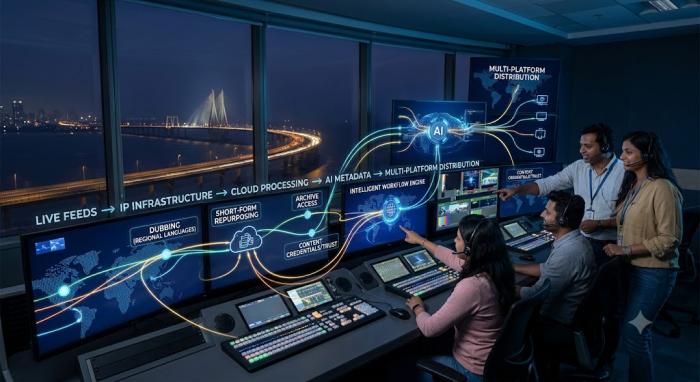
India's broadcast ecosystem is approaching a significant technological transition. The convergence of IP infrastructure, cloud computing, AI, automation and advanced streaming is changing not only how content is produced and delivered, but also how media organisations manage their businesses. The emerging opportunity lies in connecting these technologies into intelligent end-to-end workflows.
India's media market has always operated at considerable scale. Hundreds of television channels, rapidly expanding OTT services, regional-language networks, sports rights, digital publishers and production companies create an unusually complex content environment.
That complexity is now meeting a new generation of technology.
A modern media workflow can potentially begin with a live or recorded source, move through software-defined processing, use AI for metadata and localisation, generate multiple versions for different platforms and deliver them through cloud-enabled distribution systems.
The result is a media operation that is increasingly software-driven.
For broadcasters, this can change the economics of content. A programme no longer needs to remain a single finished television product. It can become a collection of assets that can be repurposed for multiple platforms, languages and audiences.
AI can identify content within large archives and make those libraries more useful. Automated transcription can make footage searchable. Translation and captioning can accelerate localisation. Generative technologies can support promotional content and short-form versions.
Cloud infrastructure provides the flexibility to process and distribute these assets according to demand.
Live streaming adds another layer.
Major sports and entertainment events can generate enormous volumes of simultaneous streams and digital assets. The same live production may need to serve television, mobile, connected-TV and OTT audiences while supporting different languages, advertising requirements and audience experiences.
This places enormous importance on resilient infrastructure.
Software-defined systems, IP networking and cloud resources can provide flexibility, but broadcasters still require the operational confidence traditionally associated with dedicated broadcast equipment.
This is why the Indian market is likely to develop through hybrid architectures. Existing SDI infrastructure will continue to support critical operations while IP, software and cloud technologies are introduced around it.

AI will increasingly sit above this infrastructure as an operational layer.
Instead of using individual AI tools for isolated tasks, media companies can begin connecting AI capabilities to their production, archive, rights, scheduling and distribution systems.
That creates the possibility of agentic workflows in which an AI system can execute a sequence of defined activities under human supervision.Yet the industry's transformation also brings a new responsibility: trust.
If AI is involved in creating, modifying, translating or distributing content, broadcasters need mechanisms to establish its provenance. Content credentials, watermarking and transparent editorial processes can help maintain confidence in the media chain.
For India, this issue will become particularly important as the country's digital audience continues to expand across languages and platforms.
The future broadcast operation is therefore not simply a cloud facility or an AI-powered newsroom. It is a connected environment in which infrastructure, content and intelligence work together.
The organisations that successfully navigate this transition will need to balance three requirements: scale, automation and trust.
India's broadcast industry has already begun moving in that direction.The next phase will be about connecting the technologies into practical, reliable workflows that deliver greater value from every piece of content while retaining the editorial and operational discipline on which broadcasting depends.