From Broadcast Infrastructure to Intelligent Media Operations

The Indian broadcast industry is moving beyond the traditional hardware-centric model towards an environment where IP, cloud, software and artificial intelligence increasingly work together. The result is not simply a more flexible infrastructure, but the emergence of intelligent media operations capable of automating workflows, scaling resources and supporting increasingly complex content requirements.
For decades, broadcast infrastructure was built around dedicated hardware, fixed facilities and carefully engineered signal paths. That model remains important, particularly for live television, but the architecture surrounding it is changing rapidly.
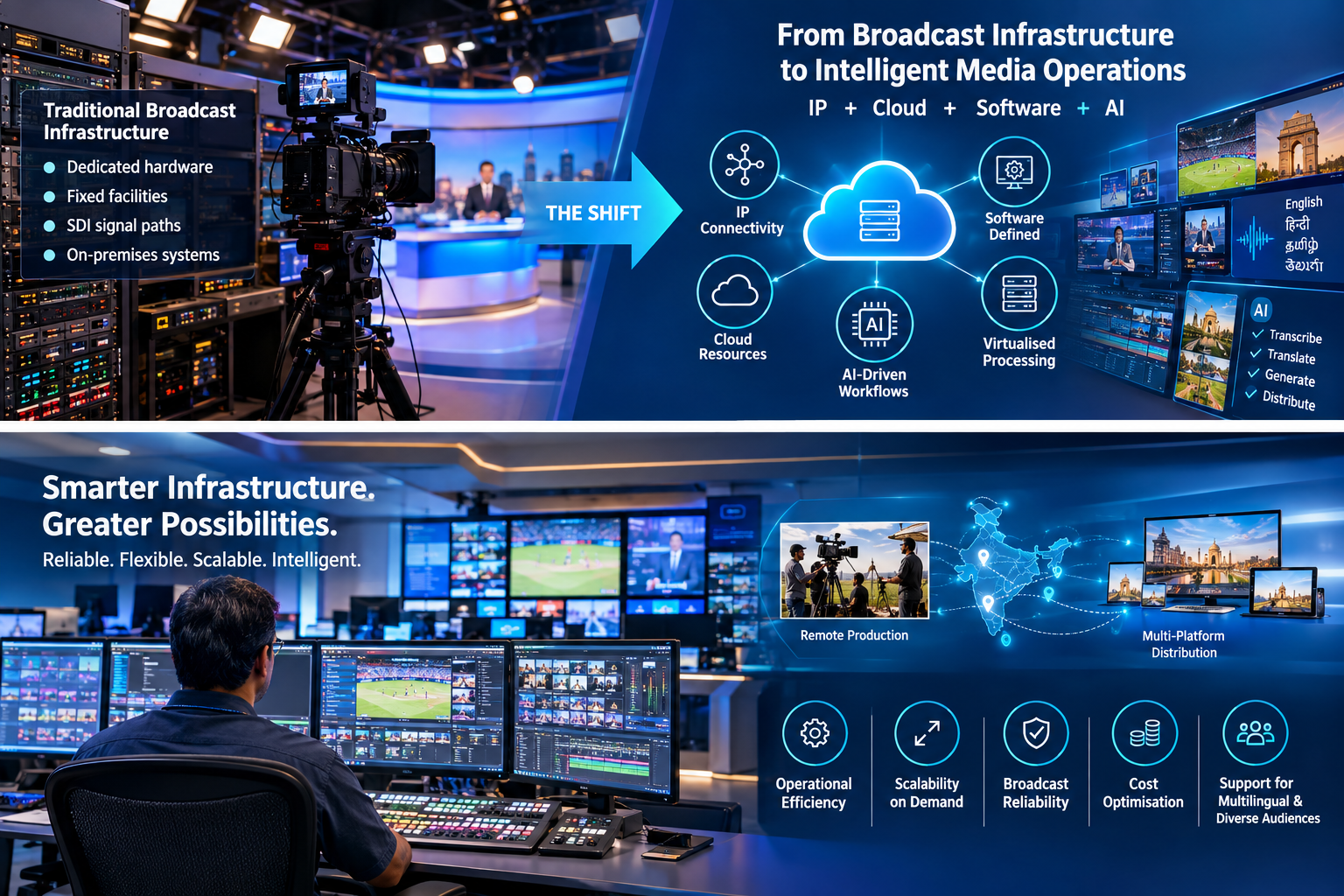
Software-defined infrastructure, IP connectivity, virtualised processing and cloud resources are allowing broadcasters to rethink how production and distribution systems are designed. Standards such as SMPTE ST 2110, along with contribution technologies such as SRT, are helping create the foundations for distributed media workflows.
For India, this transition is particularly relevant. Broadcasters and media companies operate across a highly diverse market, with multiple languages, platforms, distribution networks and audience segments. The ability to create, process and distribute content flexibly can therefore have significant operational value.
Artificial intelligence is becoming an important layer within this transformation.
The first generation of media AI focused largely on experimentation—automated transcription, captioning, image generation, translation and content creation. The next stage is about connecting AI to the systems that actually operate a media organisation.
An AI system could potentially identify material in an archive, retrieve relevant assets, check metadata, establish rights information, generate captions and translations, create short-form versions and prepare content for distribution. Instead of functioning as an isolated application, AI becomes part of the workflow.
This is where technologies such as Model Context Protocol (MCP) are attracting attention. Standardised interfaces between AI systems and software applications could allow organisations to connect intelligent agents with existing systems rather than replacing their entire technology infrastructure.
The opportunity for Indian broadcasters is substantial. Large archives, multilingual programming and extensive content libraries create numerous opportunities for automation. A single programme can potentially be converted into multiple language versions, promotional clips, social-media assets, searchable metadata and digital formats with substantially less manual intervention.
However, automation cannot compromise broadcast reliability.
Newsrooms, master control rooms, playout operations and live sports environments demand predictable performance. Hardware, software, IP networks and cloud resources will therefore increasingly coexist rather than one completely replacing another.
The economics are changing as well. Instead of building infrastructure around permanently dedicated resources, broadcasters can increasingly think in terms of services and capabilities that can be provisioned according to demand.
Remote production is another beneficiary. Production teams can work across locations while centralised systems manage processing, storage, collaboration and distribution.
The biggest change, however, may be conceptual. A broadcast facility is gradually becoming less a collection of physical equipment and more an intelligent software-controlled environment.
For Indian broadcasters, the challenge will be to modernise without disrupting established operations. Legacy SDI infrastructure will continue to coexist with IP and cloud systems for years.
The transition will therefore be evolutionary rather than revolutionary.
The broadcast infrastructure of the future will combine hardware reliability with software flexibility, cloud scalability and AI-driven intelligence. The objective is not simply to make broadcasting more automated, but to create an infrastructure capable of responding faster to the demands of a fragmented, multilingual and increasingly digital Indian audience.